Introduction
This article is intended for everyone who wants to understand how diamond clarity determines its value and how to choose the most suitable diamond for jewelry or investment. We will discuss what diamond clarity is, how it is determined, what influence it has on price, and what choices it can lead to. In this article, you will learn why diamond clarity is important, how it is assessed, and how it determines price and selection.
History of Diamonds
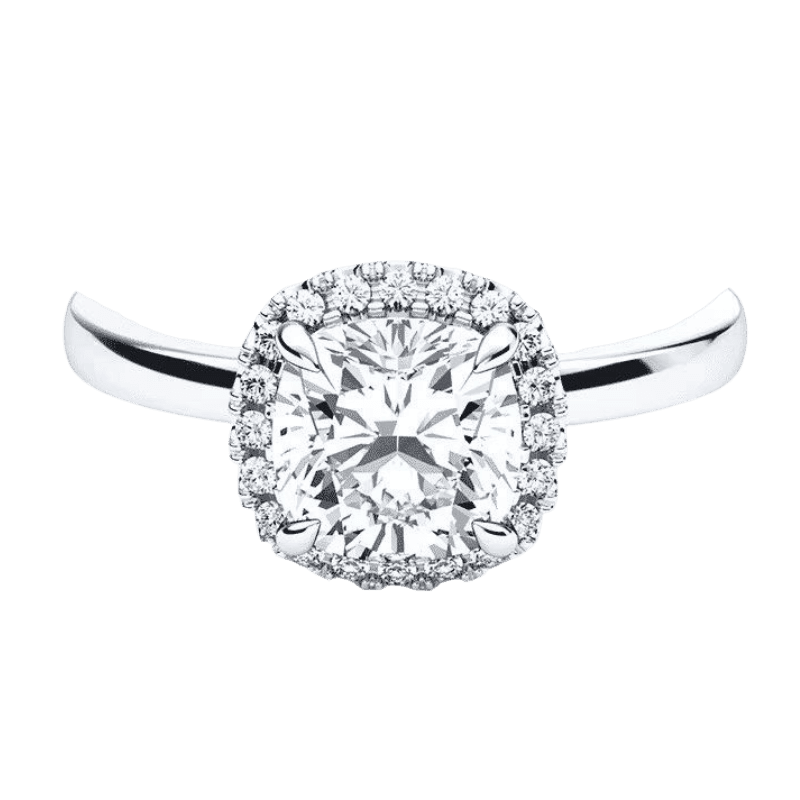
The diamond is a gemstone with a history spanning thousands of years and many world cultures. Even in ancient civilizations, diamonds were considered special because of their beauty, rarity, and extraordinary hardness. Diamond and brilliant are often mentioned together, but it is important to know that all brilliants are diamonds, but not all diamonds are brilliants – a brilliant is just one of many ways a diamond can be cut. The first diamonds were mined in India, and later they were discovered in Africa, Brazil, and other countries. Today, diamonds are extracted in various regions of the world, and lab-grown diamonds, which are not inferior to natural ones in their properties, are also becoming increasingly popular. If you are looking for an elegant piece of jewelry, a popular choice is white gold engagement rings, symbolizing eternal love.
What is Diamond Clarity?
A diamond is one of the most valuable gemstones, and its clarity (or transparency) is one of the four main criteria used to assess the quality level of the stone. Clarity, along with color, carat, and cut, is assessed by certified specialists to ensure the quality of the diamond. Diamond clarity indicates how many inclusions, spots, or other internal defects a brilliant has, and the combination of these characteristics determines the diamond’s value and appeal. Inclusions are natural traces of minerals or other substances inside the diamond, formed over millions of years during natural processes.
Diamond Clarity Chart
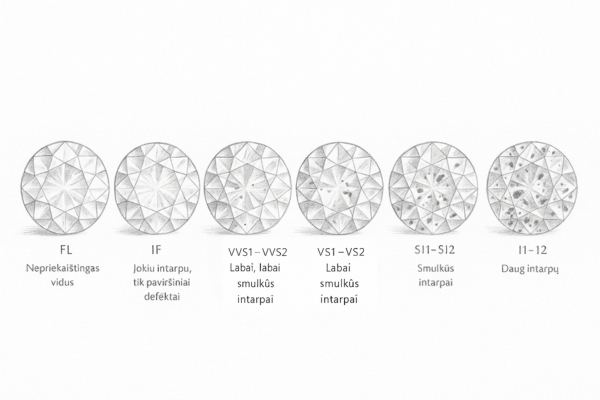
The diamond clarity chart is used worldwide. It begins with FL (Flawless), where the diamond has no visible defects even under 10x magnification, and ends with I3 (Included), where inclusions are visible to the naked eye.
Next, we will discuss how clarity affects a diamond’s brilliance and what characteristics inclusions determine.
Diamond Clarity and Brilliance
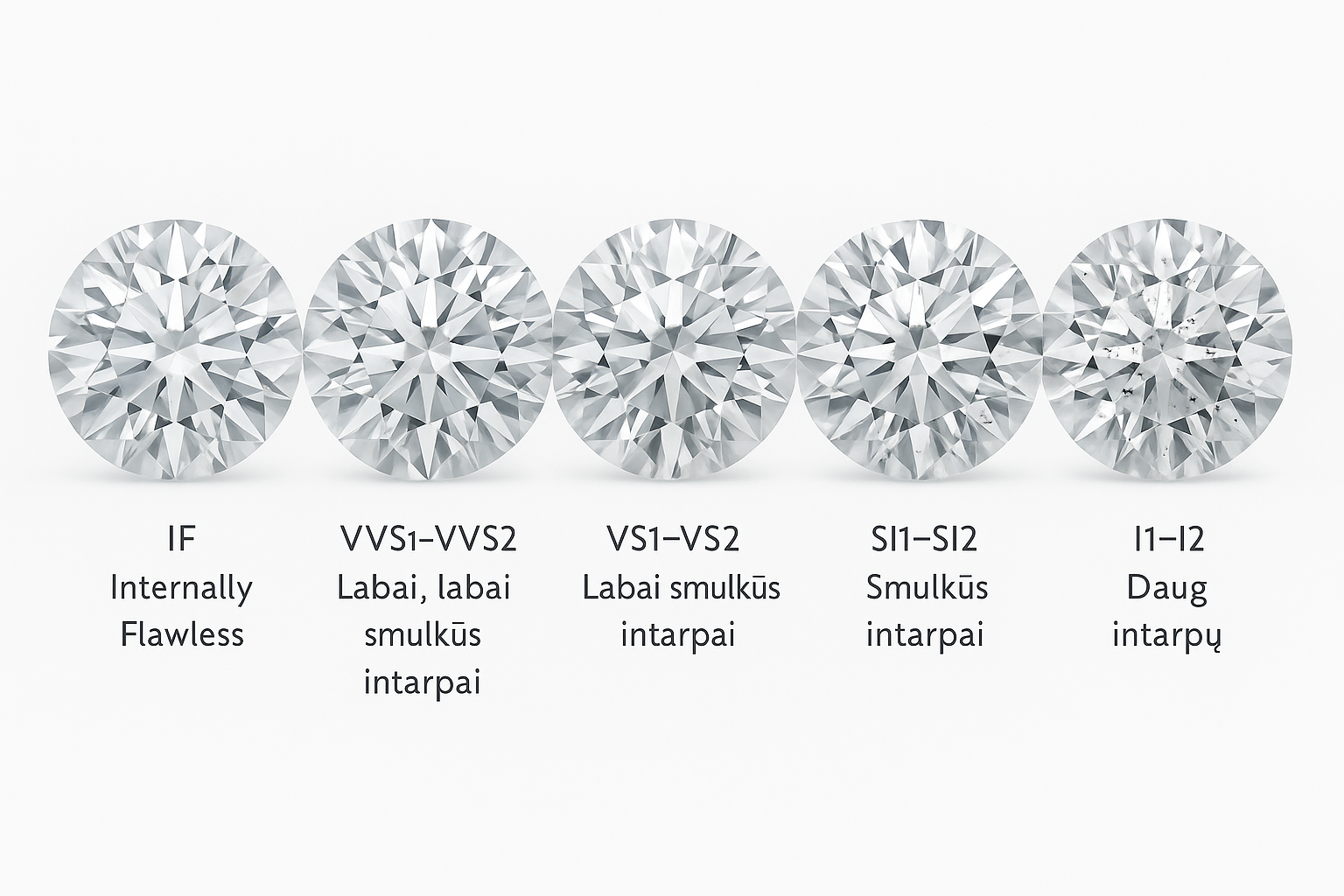
Every inclusion reduces the diamond’s ability to refract and reflect light, but the diamond’s cut is also very important, as it determines optimal light reflection. A brilliant is so highly valued for its special sparkle, so clarity directly determines whether it will look bright or duller.
Diamond Inclusions
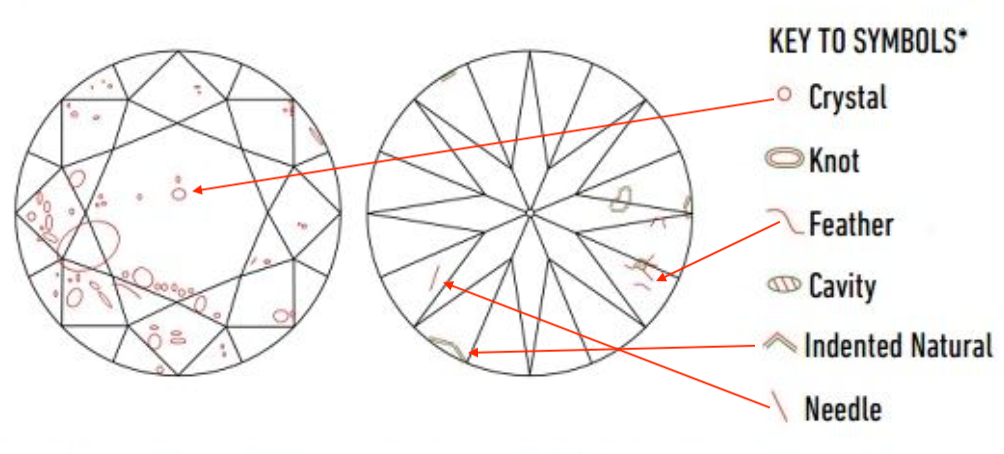
Inclusions are natural elements created by nature. These can be small lines, crystals, or spots. They make each diamond unique.
Diamond Clarity Comparison According to GIA
According to the GIA (Gemological Institute of America) – the world’s largest diamond grading laboratory – FL and IF diamonds are extremely rare and very expensive. The VVS, VS, and SI categories cover most of the brilliants on the market.
The GIA diamond clarity chart is the global standard; many international laboratories such as HRD, IGI, etc., use it, but the Lithuanian Assay Office uses the CIBJO (World Jewellery Confederation) assessment. This means that buyers may notice different entries in certificates, although they essentially mean the same thing.
Diamond Clarity in Lithuania, CIBJO (Lithuanian Assay Office) Assessment
The CIBJO classification uses the terms LC, VVS, VS, SI, and Piqué (P1–P3). For example, a GIA SI2 might be graded as Piqué 1 or even Piqué 2.
Differences Between GIA and CIBJO
Diamond Clarity Chart, Comparison: GIA vs CIBJO
| GIA Clarity Grade | Description according to GIA | CIBJO Assessment (used in the Lithuanian Assay Office) |
|---|---|---|
| FL (Flawless) | No inclusions or blemishes visible even under 10x magnification | LC (Loupe Clean) |
| IF (Internally Flawless) | No inclusions, only surface blemishes | LC (Loupe Clean) |
| VVS1 | Very, very small inclusions, difficult to see | VVS1 |
| VVS2 | Very small inclusions, slightly easier to see | VVS2 |
| VS1 | Very small inclusions, difficult to see under 10x magnification | VS1 |
| VS2 | Very small inclusions, easier to see under 10x magnification | VS2 |
| SI1 | Small inclusions. Noticeable inclusions under 10x magnification, often invisible to the naked eye | SI1 |
| SI2 | Small inclusions. Noticeable inclusions under 10x magnification, sometimes visible to the naked eye | SI2 |
| I1 | Inclusions visible to the naked eye, may affect brilliance | Piqué 1 (P1) |
| I2 | Many inclusions, significantly affects transparency | Piqué 2 (P2) |
| I3 | Very many inclusions, reduces the stone’s durability | Piqué 3 (P3) |
- GIA uses a letter-based system (FL, IF, VVS, VS, SI, I) with sub-steps.
- CIBJO uses the terms LC, VVS, VS, SI, Piqué (P1–P3).
- To a buyer, “Piqué” might sound harsher than “Included (I)”, even though it is the same assessment, just according to a different standard.
- The Lithuanian Assay Office applies a stricter assessment and allows for about a 20% margin of error, so a stone with GIA SI2 might be recorded as Piqué 1 or even Piqué 2.
Clarity by Diamond Shape: Which Shapes Reveal Inclusions and Which Hide Them?

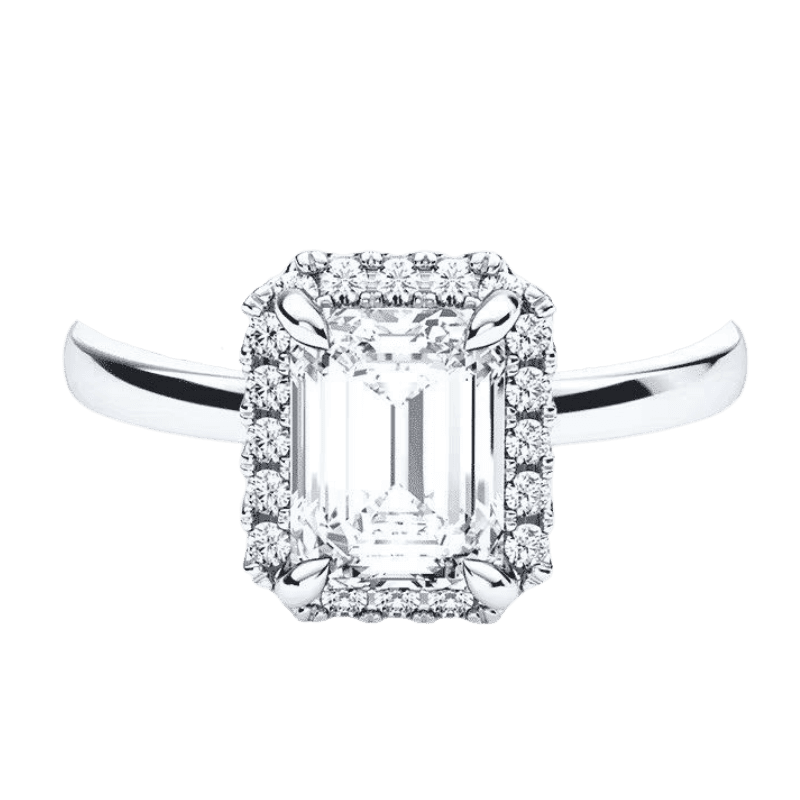
Diamond clarity is one of the most important quality criteria, but its impact also depends on the chosen diamond shape. Rectangular shapes – emerald, asscher, baguette – due to their “step cut” faceting, have large open facets, making even the slightest inclusions easily visible. For this reason, higher diamond clarity grades – from IF to VVS or VS1 – are recommended for such stones so that the diamond looks transparent and luxurious.
Meanwhile, brilliant-cut diamonds – round brilliant, radiant, pear – are able to hide inclusions due to their many small facets and strong brilliance. Even VS2 or SI1 clarity diamonds in these shapes can look very aesthetic, as the sparkle diverts attention from internal flaws. The Radiant shape is particularly valued for its ability to mask inclusions, and the pear cut allows them to be hidden in the narrower part of the stone.
When choosing a diamond, it is necessary to evaluate both clarity and shape – some require higher quality, while others offer an attractive compromise. Such a choice allows for a combination of great appearance, attractive price, and flawless sparkle.
How Shape Affects Perception of Clarity?
A round brilliant often hides inclusions better than rectangular or other shapes. Therefore, shape also influences the perception of clarity.
The Importance of Diamond Clarity
Clarity directly affects the price of a diamond. You can choose from various diamonds based on clarity level and other parameters, depending on your needs. The fewer inclusions a diamond has, the more valuable it is. This is important both when choosing jewelry – rings, earrings, or pendants – and when investing in investment diamonds.
Clarity and Jewelry Selection
If you are choosing for everyday wear, you do not necessarily need to buy an FL clarity diamond. SI1 or VS1 can be a great choice because the difference is not visible to the naked eye.
Diamond Price by Clarity
The price of a diamond rises significantly with each clarity step. The price of a 1-carat diamond with VS1 quality can differ by thousands of euros from the same stone with SI2 clarity.
Price Examples by Clarity
| Clarity Grade | 1-Carat Diamond Price (€) |
|---|---|
| SI2 | ~1,200 |
| SI1 | ~1,800 |
| VS2 | ~2,500 |
| VS1 | ~3,500 |
| VVS2 | ~5,000 |
| VVS1 | ~7,000 |
| IF | ~12,000 |
| FL | ~15,000 |
Note: prices are indicative and depend on other parameters (color, cut, certificate).
Brilliant or Diamond?
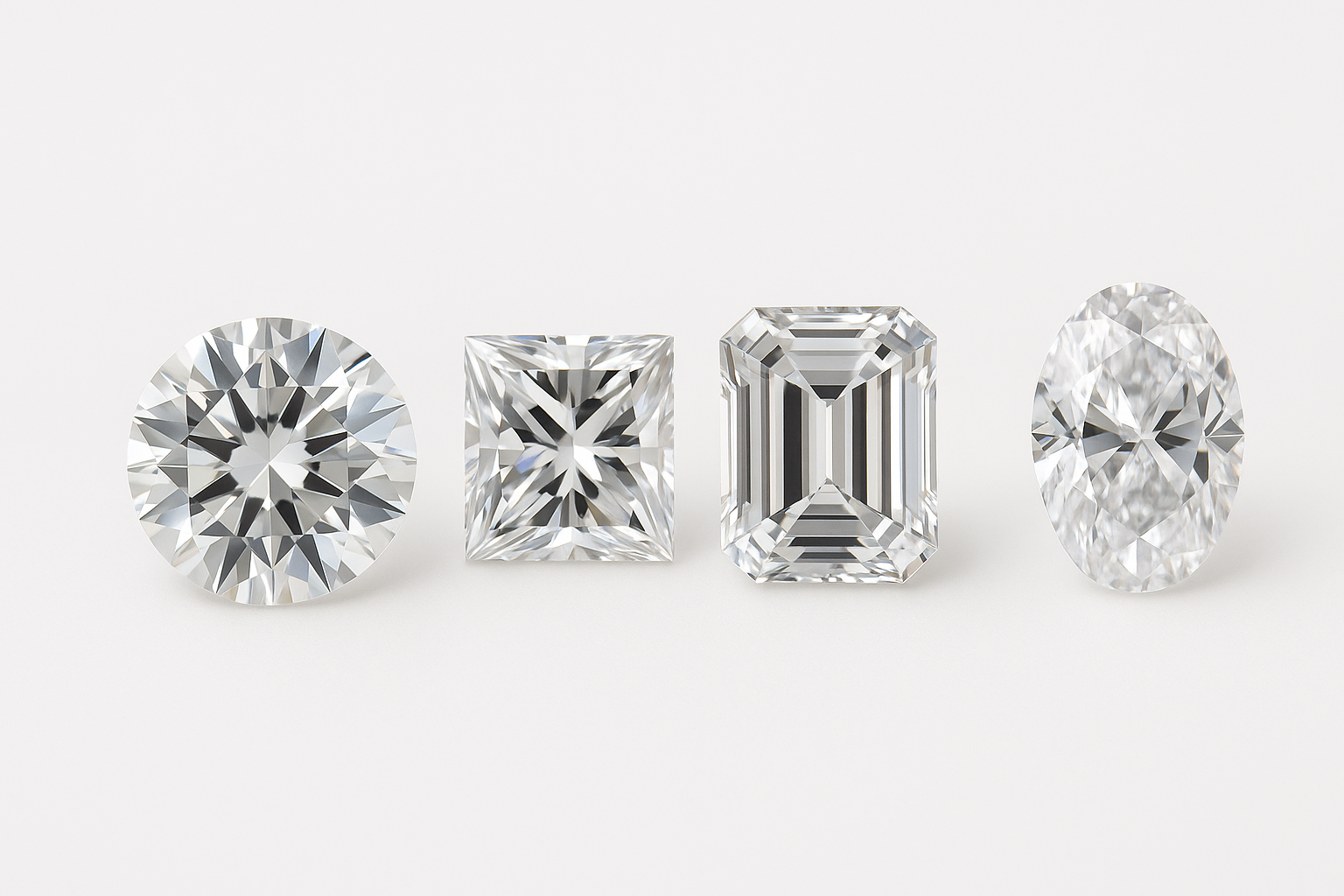
The question often arises: what is the difference between a diamond and a brilliant? A brilliant is a diamond that has been processed in a specific way – faceted to reflect light optimally, so all brilliants are diamonds, but not all diamonds are brilliants. These terms are often confused, but they describe different gemstone types. However, both diamonds and brilliants get their price based on clarity, carats, color, and cut.
A Brilliant is a Special Form
A brilliant is a diamond with 57 or 58 facets. This cut gives it a special sparkle. That’s why it’s said – a diamond is the material, but a brilliant is specifically a processed diamond.
Why is Clarity also Called Transparency?
In Lithuania, the word “skaidrumas” (transparency) is often used. It means the same as the international term “clarity”.
Impact of Diamond Clarity on Investments
Investment diamonds must have high clarity. It is usually recommended to choose stones no lower than VS, as poorer inclusions reduce the value of the diamond in the long run.
Investment Diamonds and Their Market Share
Investment diamonds account for only about 5% of all diamonds sold worldwide. Therefore, an investment diamond is rare and highly valued.
Diamond Carat Price and Clarity
The price of a diamond per carat depends not only on weight but also on clarity. The price of a 1-carat diamond can differ several times if the clarity grade is different, ranging from 1,200 EUR per carat to 15,000 EUR per carat.
Brilliants and Diamonds in Jewelry
Rings, earrings, and pendants with brilliants are the most frequently purchased jewelry – these pieces are often considered symbols of luxury and gemstones. Each diamond is unique due to its clarity and other characteristics. However, buyers rarely stop to think that their diamond has a certain clarity level.
Do Lab-Grown Diamonds Have Inclusions?
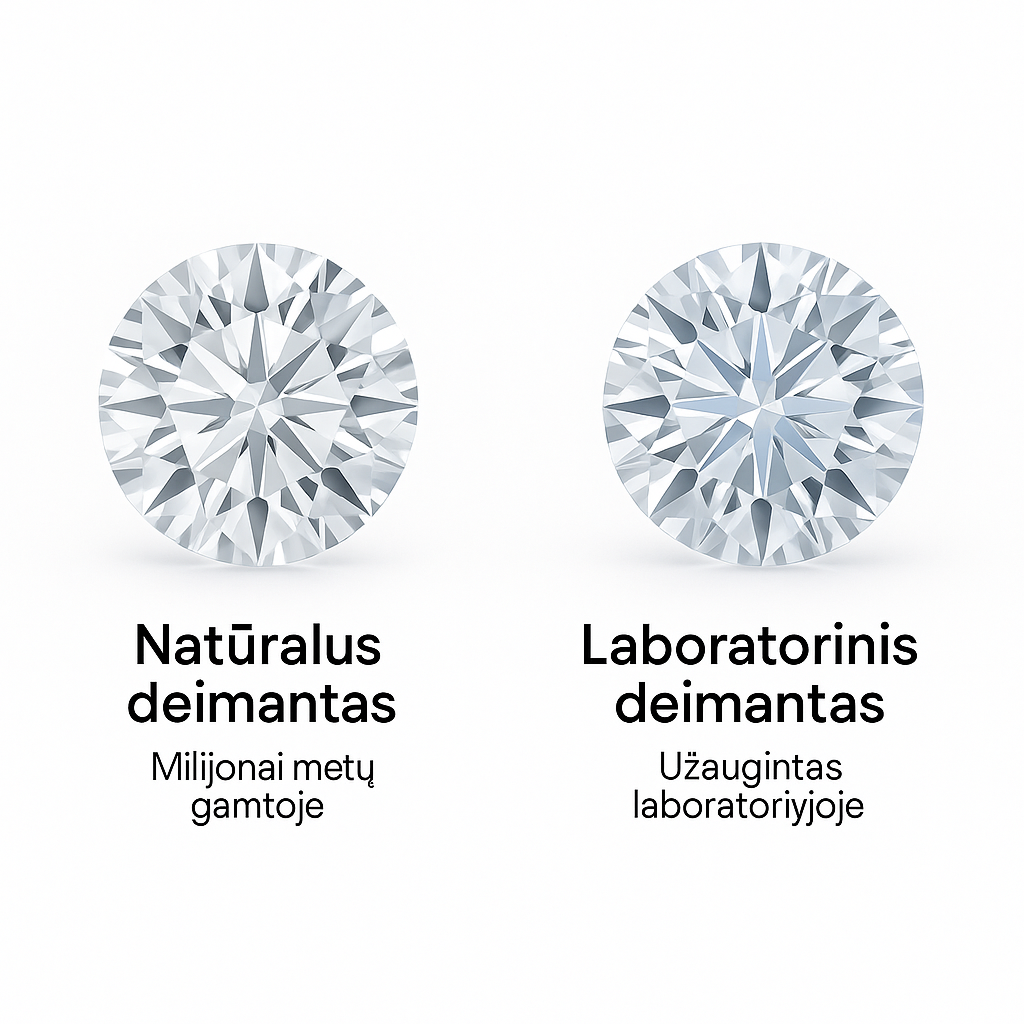
Lab-grown diamonds can also have inclusions, but their nature is different. They are often metallic traces or growth lines.
What is the Difference Between Lab-Grown and Natural Diamonds?

Lab-grown diamonds have the same chemical composition as natural ones. Only their origin differs – they are increasingly used in various jewelry pieces.
Lab-Grown Diamonds and Price
Lab-grown diamonds are cheaper than natural ones. This is due to their production process, which is faster and more efficient.
Are Lab-Grown Diamonds Suitable for Investment?
Because their supply can be increased, lab-grown diamonds are not suitable as investment diamonds. If you are looking for exclusive diamond jewelry, e.g., diamond tennis bracelets, we recommend choosing natural diamonds.
Diamond Clarity Myths
Some people think that only FL or IF is worth buying. However, VS1 or SI1 brilliants are practically just as beautiful to the naked eye.
What to Choose for Jewelry?
If you are looking for an engagement ring, choosing the VS or SI category is sufficient. It ensures a good price-to-quality ratio. And if you are considering other luxury gifts, take a look at diamond bracelets.
Investment Diamond by Carat
The larger the carat, the higher the value. The most popular are 0.30 ct, 0.50 ct, 1 ct brilliant prices, and 3 ct and 5 ct stones.
How to Choose an Investment Diamond?
If you want to invest, choose a stone with a GIA certificate, at least VS clarity, and D-E color. This will help preserve value for the future.
Investment Diamond – A Family Heirloom

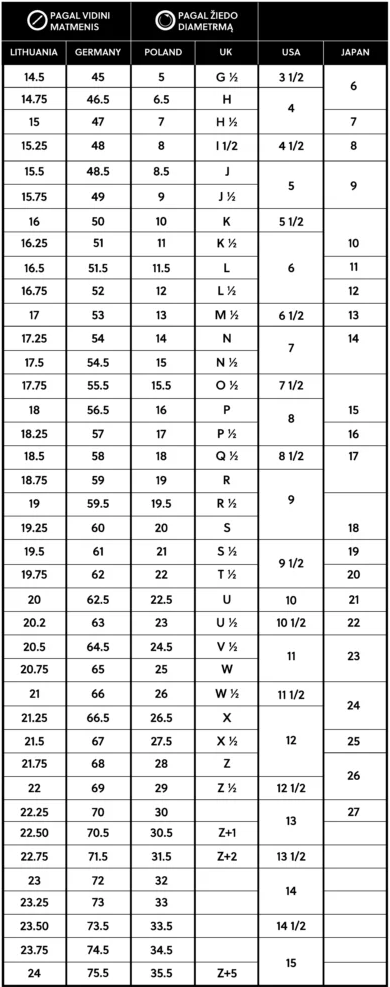
An investment diamond can become a family asset passed down from generation to generation. It is not only a gemstone but also a symbol of values and a special gift. If you want to give a diamond ring, it is important to choose the ring size correctly.
FAQ: Diamond Clarity (Transparency)
- What is diamond clarity and why is it important?
Diamond clarity indicates the number of inclusions and their visibility. It is important because it directly determines brilliance and price. - How does diamond clarity affect the price?
The clearer the diamond, the higher its value. The difference between SI2 and VS1 clarity can reach thousands of euros. - What are the diamond clarity grades according to GIA?
According to GIA, clarity is divided into FL, IF, VVS, VS, SI, and I categories. - What is the difference between GIA and CIBJO diamond clarity assessments?
GIA uses the FL–I scale, while CIBJO uses LC, VVS, VS, SI, Piqué. The CIBJO system is applied in Lithuania. - Is it worth choosing only FL or IF clarity diamonds?
Not necessarily. VS or SI category diamonds look very aesthetic to the naked eye and are cheaper. - Which diamond cuts show inclusions the most?
Emerald and Asscher shapes highlight inclusions more, while Round Brilliant or Radiant hide them. - Do lab-grown diamonds have inclusions?
Yes, but they differ from natural ones – usually they are metallic traces or growth lines. - How much does a diamond cost based on clarity?
A 1 ct diamond can cost from ~1,200 € (SI2) to 15,000 € (IF or VVS). - What diamond clarity is best for an engagement ring?
Usually, VS1–SI1 is recommended – good price and excellent appearance. - Is diamond clarity important for investments?
Yes. For investment diamonds, it is recommended to choose stones no lower than VS clarity with a GIA certificate.