Diamond, ruby, sapphire, emerald – gemstone certificates
Gemstone certificates
Gemstones such as diamonds, rubies, emeralds, or sapphires have always been valued for their beauty and exclusivity. A diamond is a natural mineral composed of carbon atoms that form a special crystalline structure. Also, the diamond is one of the most valuable types of gemstones, along with ruby, sapphire, and emerald.
However, only a certificate can ensure that the stone is genuine and correctly evaluated according to international standards. In this article, we will discuss why a certificate is important, what the main laboratories are, and how evaluation methodologies differ.
Certified diamonds
Certified diamonds are evaluated in independent laboratories such as GIA, HRD, IGI, or others.
They determine the diamond’s quality based on four criteria – color, clarity, carat weight, and cut quality.
A certificate ensures that the diamond is real and has a clear market value.
GIA certificate – the gold standard
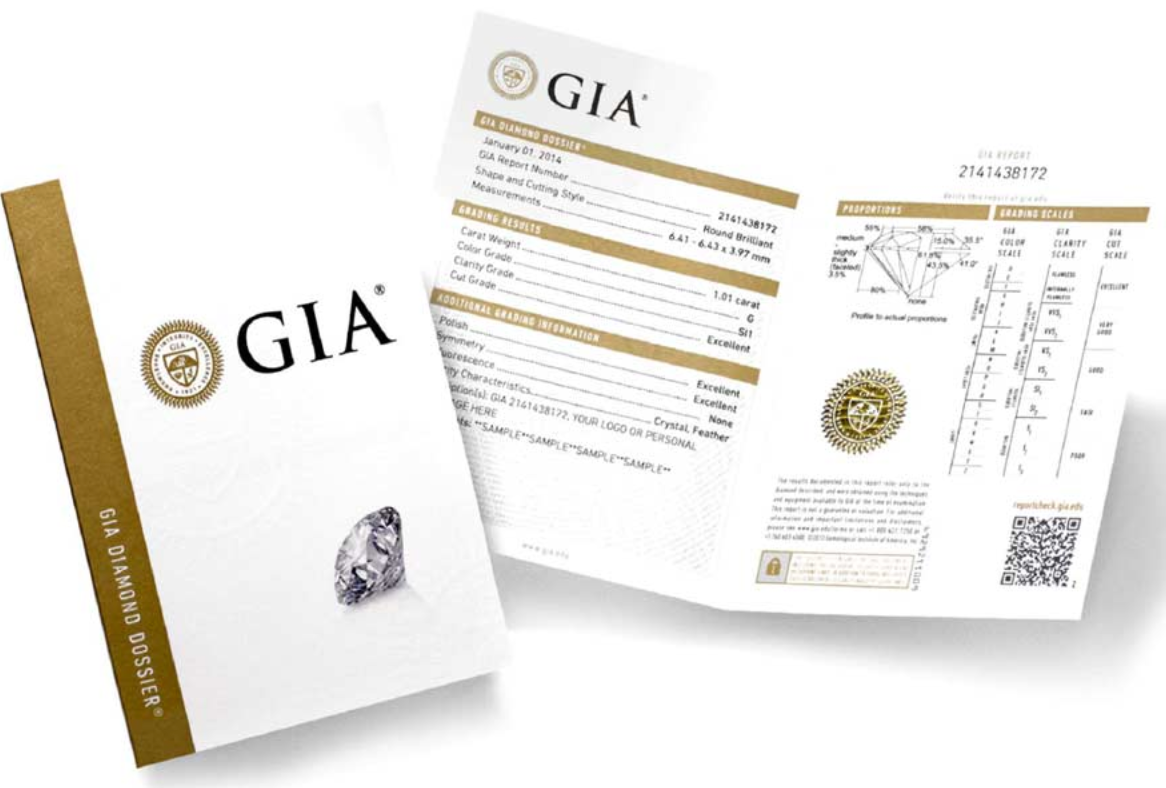
GIA (Gemological Institute of America) is the most recognized laboratory in the world.
Its certificate is considered the most reliable because it accurately shows the stone’s color, clarity, shape, and weight.
For this reason, GIA-certified diamonds are often valued higher.
🔹 Check GIA certificate – one of the most reliable laboratories in the world, evaluating diamonds according to the strictest international standards.
How to read a GIA certificate?
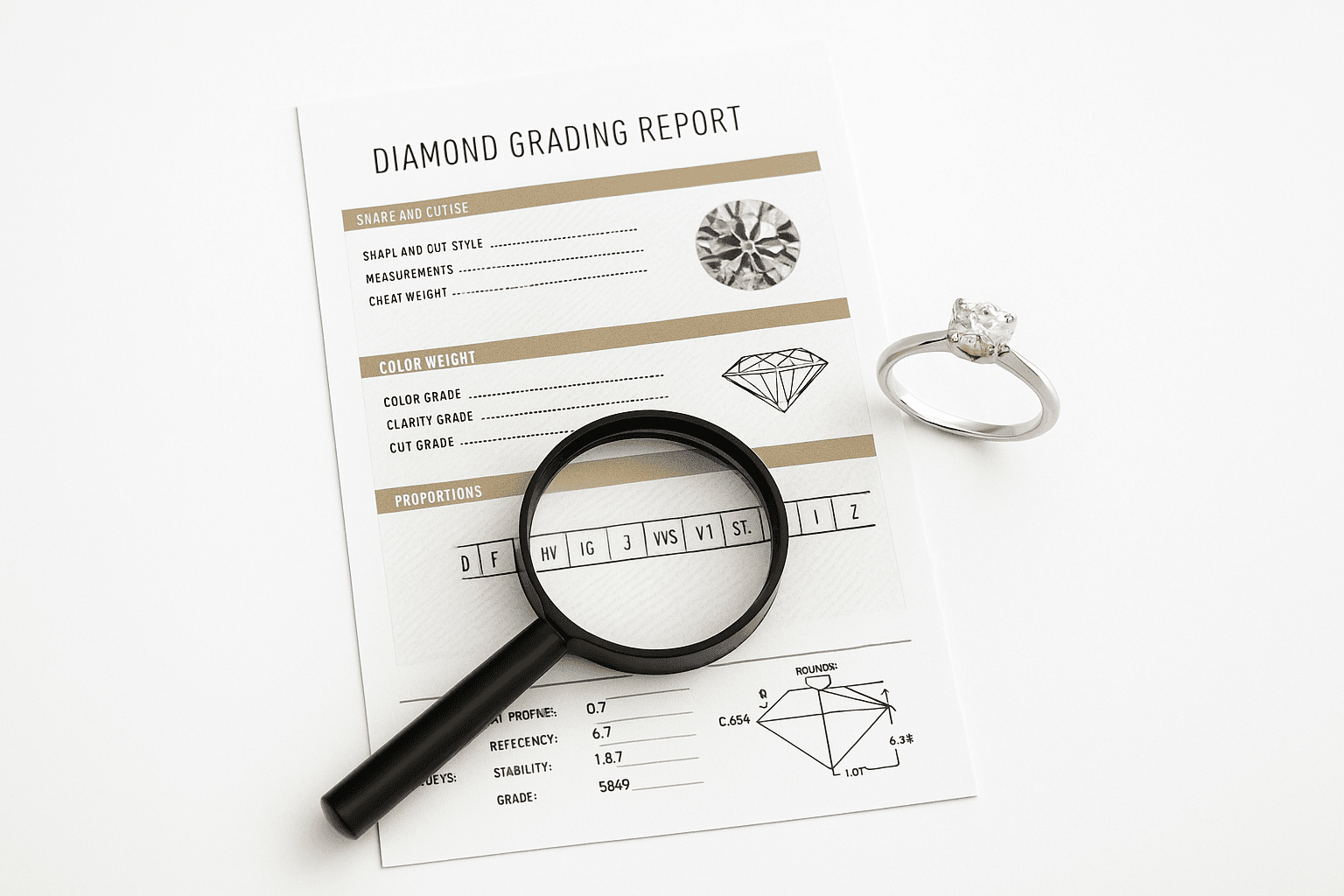
A GIA diamond certificate includes all the most important information:
- The date the diamond was certified.
- Certificate number with a laser inscription on the diamond’s girdle.
- Diamond shape and cutting style.
- Diamond dimensions.
- Carat weight (1 carat = 0.20 g, therefore the term carat in grams is also important).
- Color classification from D to Z.
- Clarity evaluation.
- Cut grade (Excellent – Poor).
- Polish and symmetry.
- Fluorescence.
Diamond clarity evaluation according to GIA
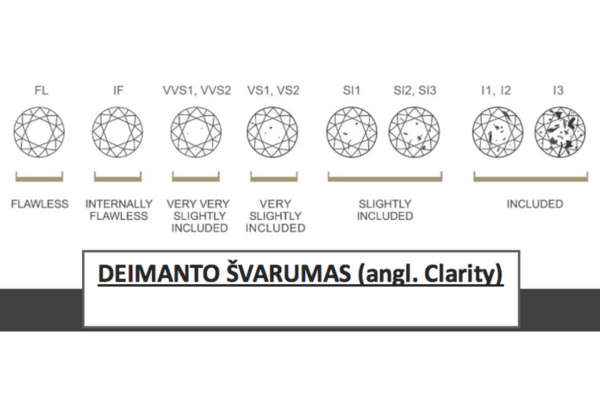
Clarity is determined by the number and visibility of inclusions. The scale starts from FL (Flawless) and ends with I3 (Included). This parameter strongly influences the price of the diamond.
Diamond color scale according to GIA
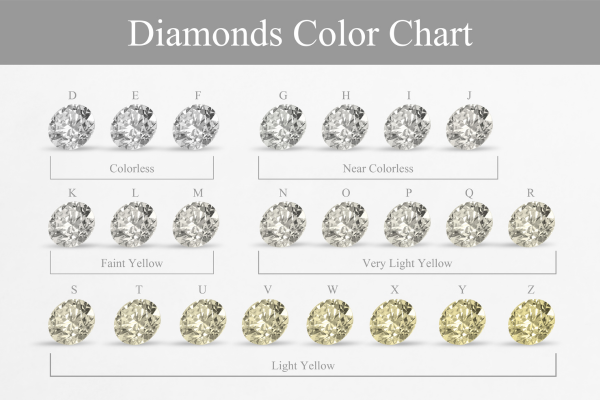
Colors are evaluated from D (colorless) to Z (yellow or brownish tint). The more colorless the stone, the rarer and more expensive it is. It is important for the buyer to know that color is one of the four main 4C criteria.
GIA proportion and inclusion diagrams
Each GIA certificate provides drawings and diagrams. They show inclusions, stone proportions, and detailed technical data. Such diagrams often also indicate the number of diamond facets and their symmetry, which determine the stone’s brilliance. This allows identifying each stone as unique.
HRD certificate
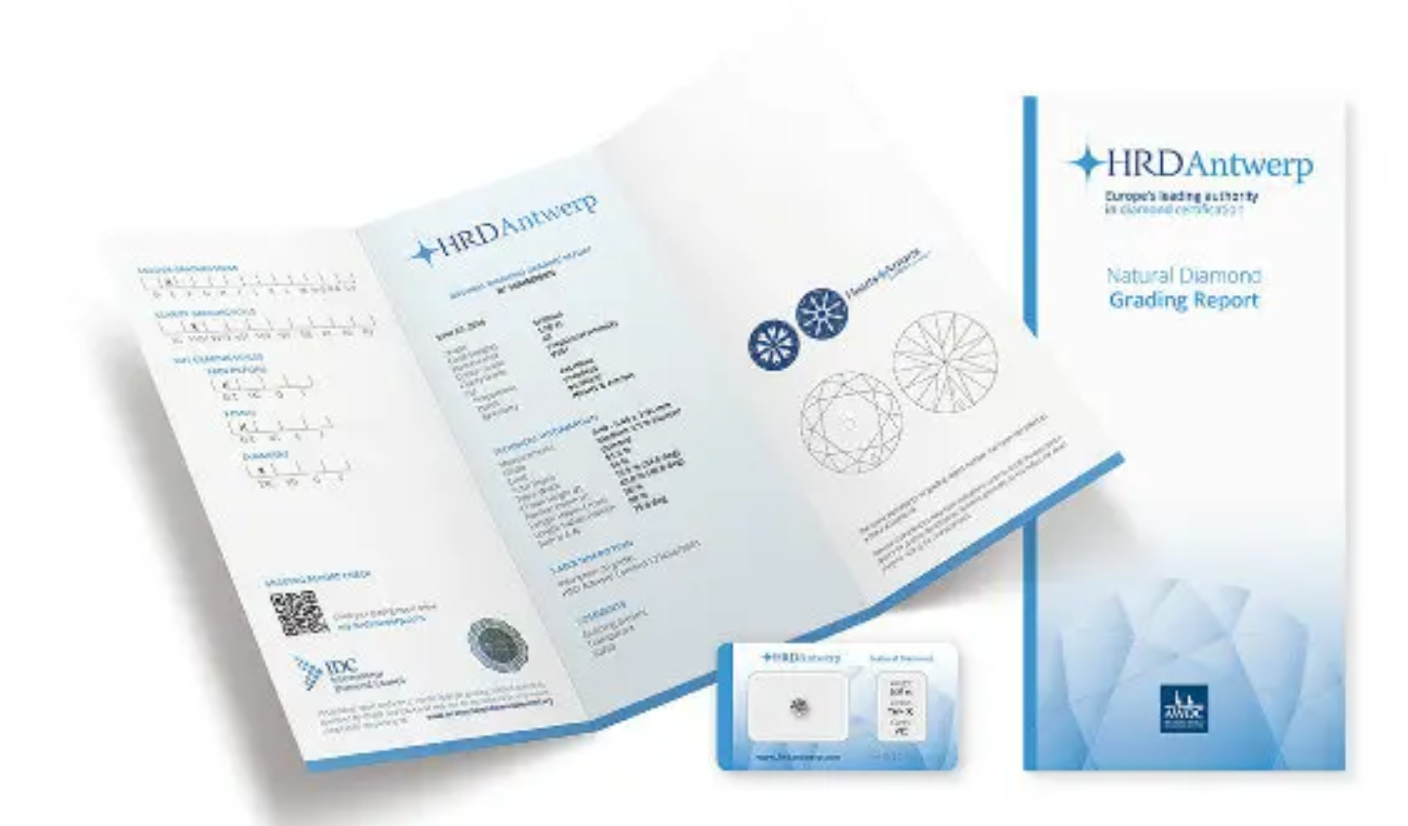
HRD (Hoge Raad voor Diamant) is a prestigious laboratory in Belgium. It is often used in Europe and is considered a reliable alternative to GIA. HRD certificates are provided in several languages and are recognized in the international market.
🔹 Check HRD certificate – a Belgian laboratory often used in the European market to verify diamond quality.
IGI certificate
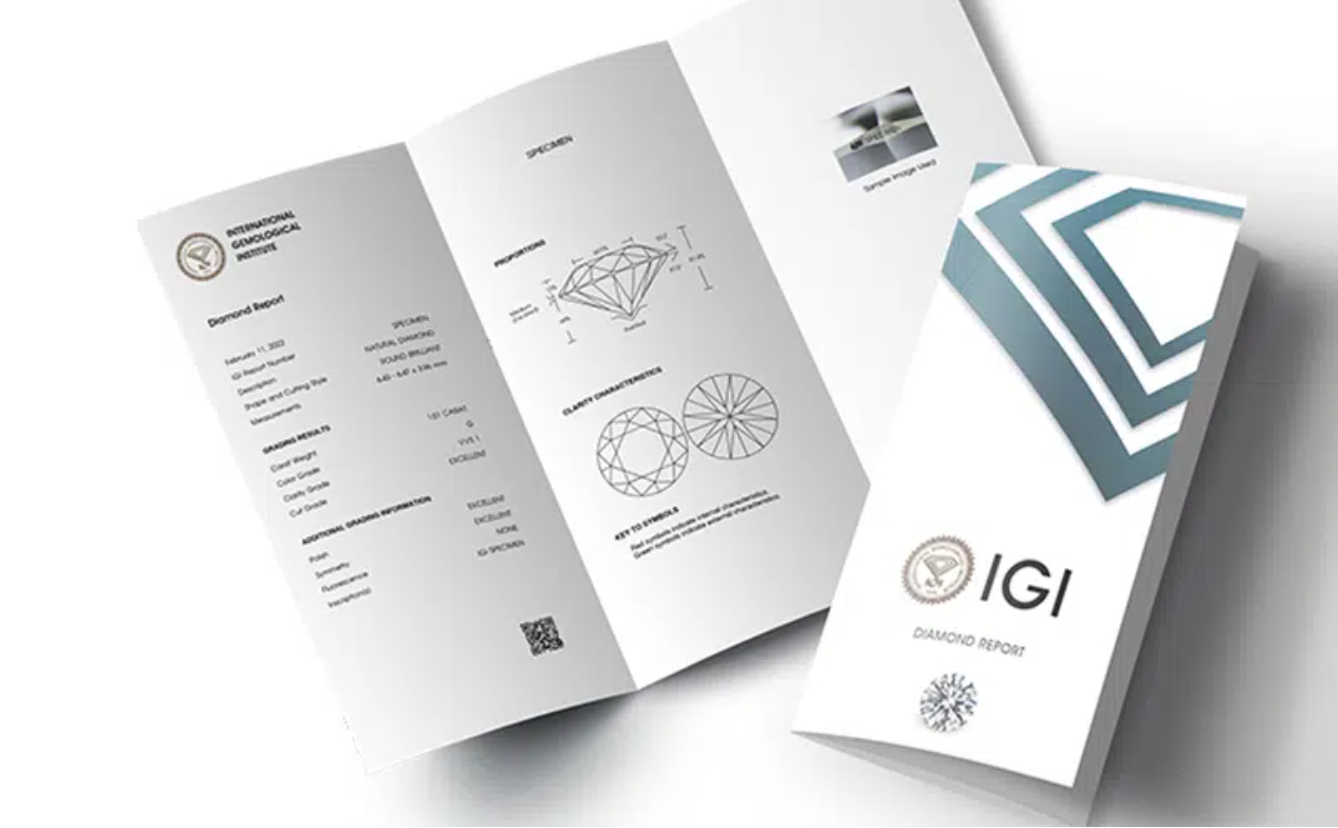
IGI (International Gemological Institute) is also widely used. IGI issues certificates for both natural and laboratory-grown diamonds. Because of this, IGI is popular among buyers looking for lab-grown diamonds.
🔹 Check IGI certificate – an international laboratory widely used for certifying both diamonds and lab-grown diamonds.
EGL certificate
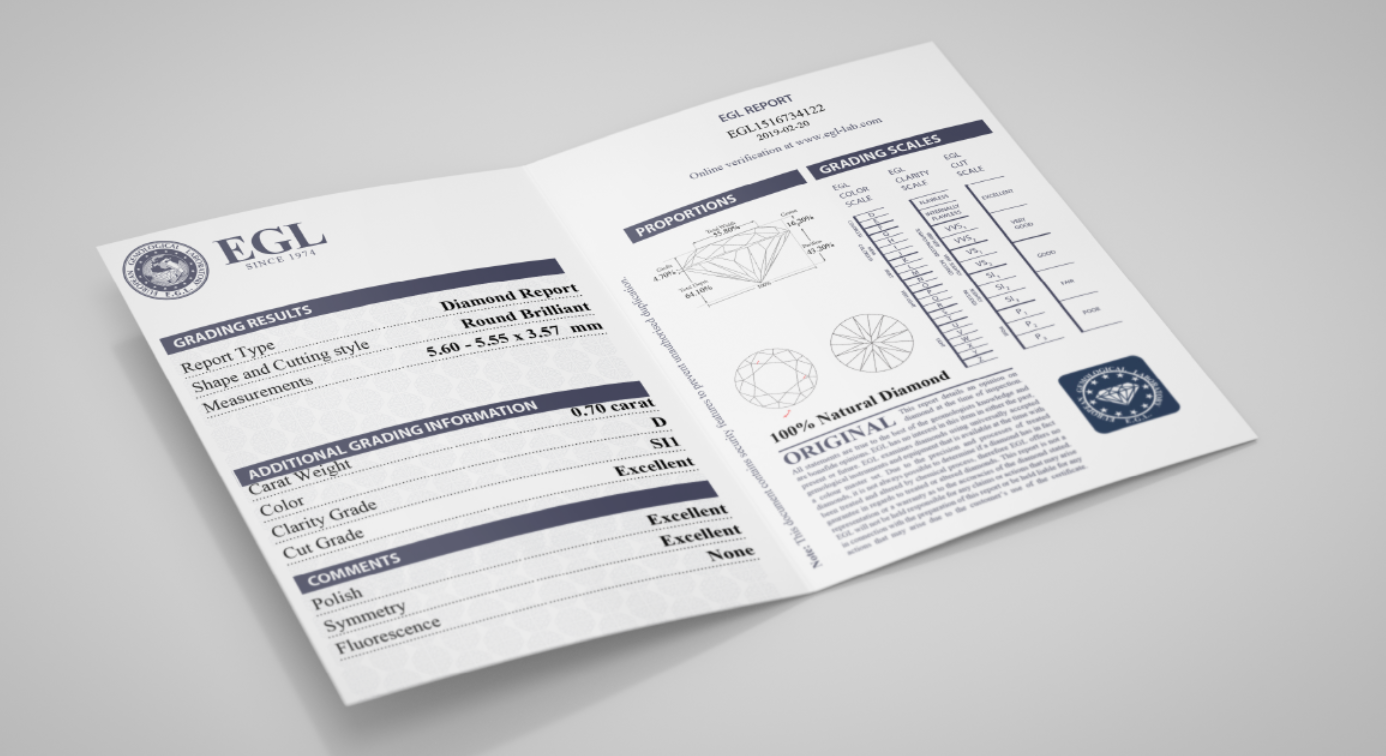
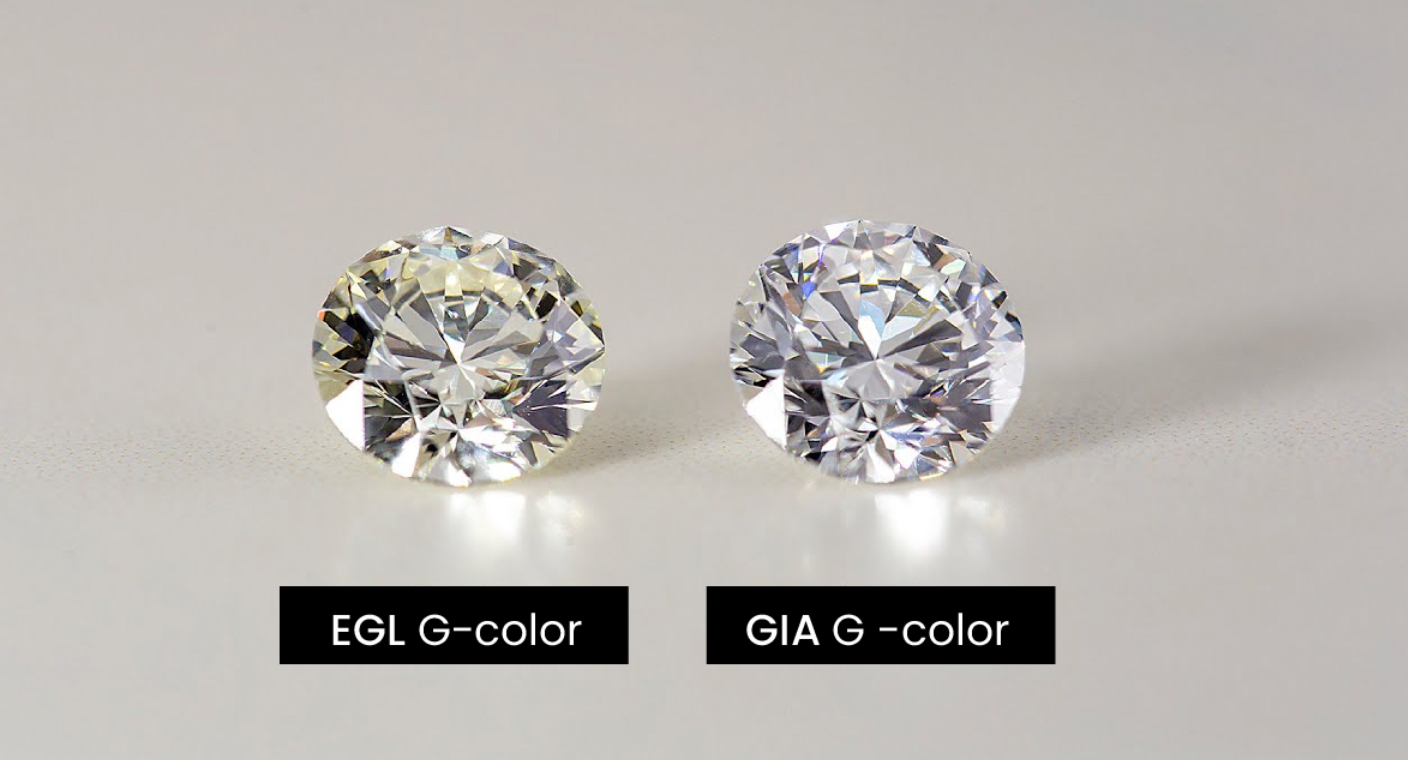
EGL (European Gemological Laboratory) also issues certificates. However, their strictness is sometimes criticized as evaluations can differ from GIA by as much as 2.5 times. Nevertheless, EGL documents are widely used in the market.
🔹 Check EGL certificate – a laboratory providing diamond quality certificates, more commonly found in the US and Europe.
Swiss laboratories for colored gemstones
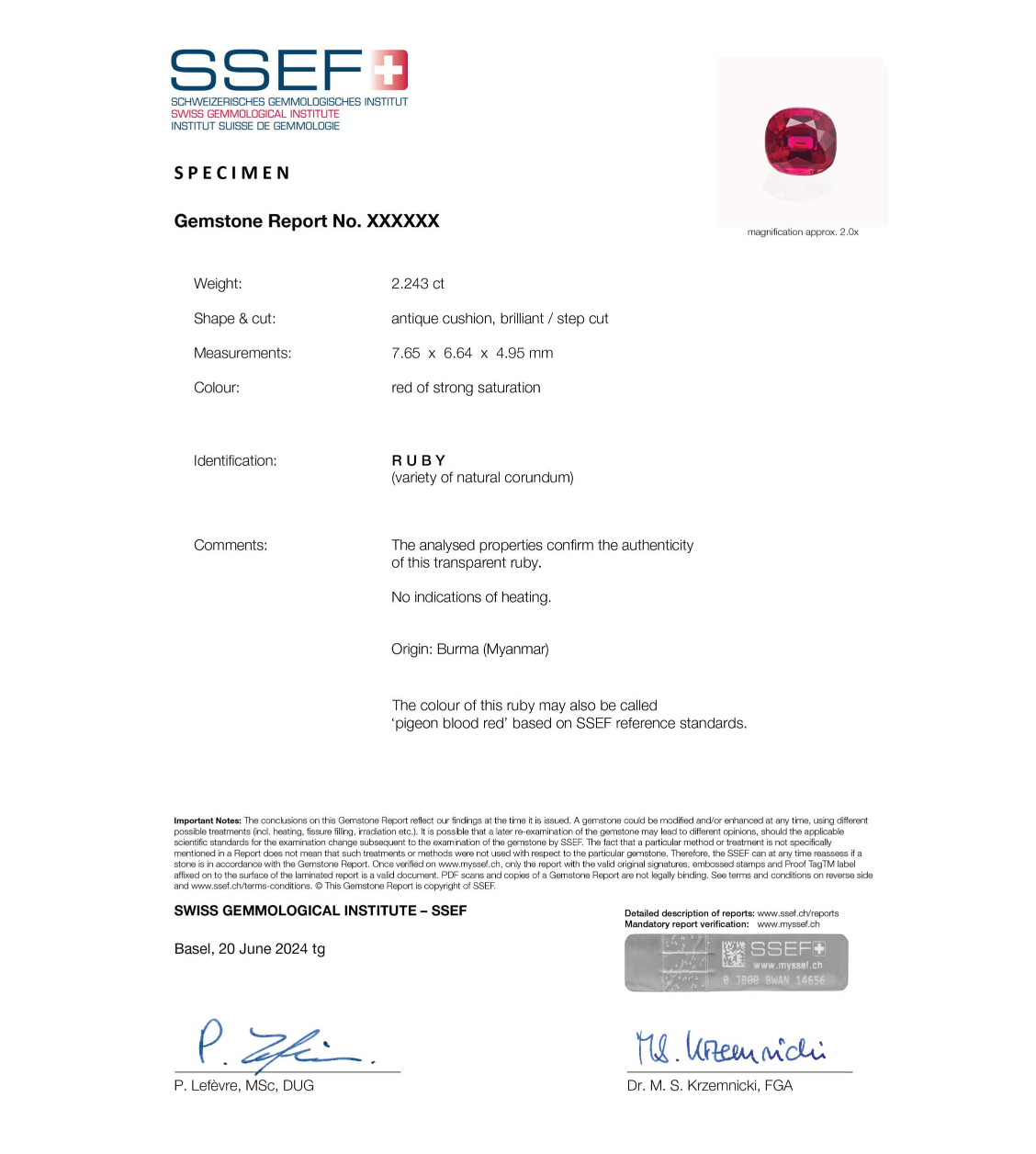
For rubies, sapphires, and emeralds, Swiss laboratories are often used. They provide detailed information about colored gemstones. It is important for the buyer to know that GIA does not always issue certificates for colored stones.
🔹 Check SSEF certificate – a Swiss laboratory especially valued for colored gemstones such as rubies, sapphires, or emeralds.
Lithuanian Assay Office – a guarantee of reliability
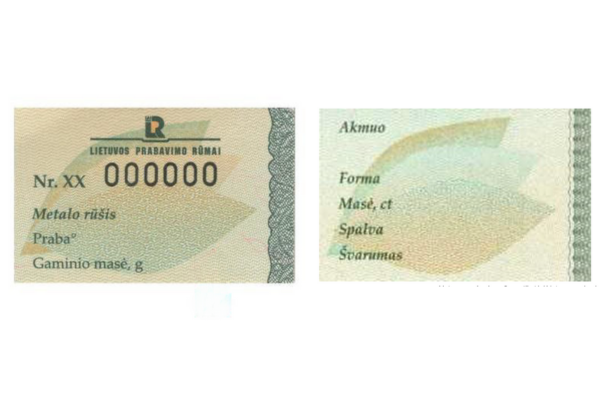
In Lithuania, international certificates are not mandatory. However, every natural diamond must be checked at the Lithuanian Assay Office.
They evaluate according to CIBJO standards and provide an official document – a certificate from the Lithuanian Assay Office.
What does the Lithuanian Assay Office check?
The Assay Office usually evaluates stones that are already set in jewelry. Therefore, they cannot examine the stone from all sides like international laboratories. Because of this, their evaluation provides for a ±20% margin of error in the certificate.
Diamond color comparison: GIA vs Lithuanian Assay Office (CIBJO standard)
| GIA color grade | Description according to GIA | CIBJO evaluation (used in the Lithuanian Assay Office) |
|---|---|---|
| D | Colorless (highest quality) | EW+ (Exceptional White +) |
| E | Colorless, barely perceptible tone | EW (Exceptional White) |
| F | Near colorless | RW+ (Rare White +) |
| G | Near colorless, barely yellowish tone | RW (Rare White) |
| H | Slightly yellowish tone, but still valued | W (White) |
| I | Noticeable yellowish tone | STW (Slightly Tinted White) |
| J | More distinctly yellowish, but acceptable | STW (Slightly Tinted White) |
| K | Clearer yellowness | TW (Tinted White) |
| L | Noticeable yellowness, lower value | TW (Tinted White) |
| M–Z | Distinct yellowness or brownness | Often combined into broader groups (e.g., Tinted, M–R, S–Z) |
✅ Important to know:
- GIA uses a letter scale (D–Z), while CIBJO uses terms (EW, RW, W, STW, TW).
- CIBJO classification is often less clear to the final buyer because it uses abbreviations that are not always intuitively understood.
- Due to these differences, it may seem to a customer that their diamond is graded lower, when in reality it is just a different classification system.
Diamond clarity comparison: GIA vs Lithuanian Assay Office (CIBJO standard)
| GIA clarity grade | Description according to GIA | CIBJO evaluation (used in the Lithuanian Assay Office) |
|---|---|---|
| FL (Flawless) | No inclusions or blemishes visible even under 10x magnification | LC (Loupe Clean) |
| IF (Internally Flawless) | No inclusions, only surface defects | LC (Loupe Clean) |
| VVS1 | Very, very small inclusions, difficult to see | VVS1 |
| VVS2 | Very small inclusions, slightly easier to see | VVS2 |
| VS1 | Small inclusions, difficult to see under 10x magnification | VS1 |
| VS2 | Small inclusions, easier to see under 10x magnification | VS2 |
| SI1 | Noticeable inclusions under 10x magnification, often invisible to the naked eye | SI1 |
| SI2 | Noticeable inclusions under 10x magnification, sometimes visible to the naked eye | SI2 |
| I1 | Inclusions visible to the naked eye, can affect brilliance | Piqué 1 (P1) |
| I2 | Many inclusions, strongly affects transparency | Piqué 2 (P2) |
| I3 | Very many inclusions, reduces the stone’s durability | Piqué 3 (P3) |
✅ Explanations:
- GIA uses a letter system (FL, IF, VVS, VS, SI, I) with small steps.
- CIBJO uses the terms LC, VVS, VS, SI, Piqué (P1–P3).
- It may seem to the buyer that “Piqué” sounds harsher than “Included (I)”, even though it is the same evaluation, just under a different standard.
- The Lithuanian Assay Office applies a more conservative evaluation, so a stone having a GIA SI2 might be recorded as Piqué 1 or even Piqué 2.
The Lithuanian Assay Office does not provide such detailed evaluations as international laboratories, so customers often have questions about why their documents lack data on Cut, Symmetry, and Polish.
Comparison: International laboratories vs Lithuanian Assay Office
Comparison table showing clearly which criteria are evaluated by international laboratories (e.g., GIA, HRD, IGI) and what the Lithuanian Assay Office evaluates (according to CIBJO standards).
| Criterion | International laboratories (GIA, HRD, IGI) | Lithuanian Assay Office (CIBJO) |
|---|---|---|
| Carats | Measured very precisely (up to 0.001 ct). | Measured, but there may be a ±20% margin of error in documents. |
| Color | Evaluated by letters from D to Z. | Evaluated according to the CIBJO system: EW, RW, W, STW, TW. |
| Hue | Recorded if the diamond has a yellowish, brown, or other tone. | Often only the general tone is recorded (e.g., yellowish, brownish), without a precise scale. |
| Clarity | Evaluated according to the GIA scale: FL, IF, VVS1–2, VS1–2, SI1–2, I1–3. | Evaluated according to CIBJO: LC, VVS, VS, SI, Piqué (P1–P3). |
| Cut | Evaluates the quality of proportions: Excellent, Very Good, Good, Fair, Poor. | Not evaluated. |
| Symmetry | Evaluated on a scale: Excellent, Very Good, Good, Fair, Poor | Not evaluated. |
| Polish | Evaluated on a scale: Excellent, Very Good, Good, Fair, Poor | Not evaluated. |
| Fluorescence | Recorded as: None, Faint, Medium, Strong, Very Strong (with color type). | Usually not specified unless obvious. |
| Proportions | Detailed information provided (table size %, depth %, crown angles, etc.). | Not provided. |
| Stone Shape | Clearly indicated (Round, Oval, Princess, Emerald, etc.). | Usually only described, e.g., “round” or “fancy shape or diamond”. |
| Laser Inscription | Number marked on the stone’s girdle is noted in the certificate. | If international, it is usually verified but not recorded. |
| Comments | May include notes about cracks, polishing, fluorescence effect. | Notes are usually minimal – only main parameters. |
✅ What the buyer must know:
- International certificates provide very detailed information, so they are the primary source allowing for the precise determination of the stone’s quality.
- The Lithuanian Assay Office provides a more simplified and stricter evaluation, which is oriented towards buyer protection, rather than an exhaustive aesthetic or technical analysis of the diamond.
- If a diamond has fluorescence or another visual effect, international certificates record it precisely, whereas the Assay Office does not.
- Therefore, if you buy a diamond with a GIA, HRD, IGI, or other international certificate, you have much more detailed information than from the Assay Office document alone.
- Therefore, it is recommended to have both documents – the international certificate and the Lithuanian Assay Office finding.
Margin of error in evaluation
Interestingly, the Lithuanian Assay Office allows for up to a 20% margin of error. This is clearly announced in official documents. This means that the color or clarity may differ from GIA.
Buyer protection in Lithuania
The Assay Office is focused on consumer rights. They protect the buyer more, which is why their evaluation is stricter.
Because of this, the documents may look confusing, but they ensure transparency.
Certificates in Lithuania – which ones are mandatory?
It is important to know that in Lithuania, mandatory certificates are not only for diamonds. Ruby, sapphire, emerald must also be checked at the Assay Office. Meanwhile, for laboratory-grown diamonds, a certificate is not mandatory.
Lab Grown Diamonds and their certification
Artificial diamonds are not the same as laboratory-grown ones. A laboratory-grown diamond is a real diamond grown in a laboratory, while artificial ones are imitations (moissanite, cubic zirconia).
It is important not to confuse these concepts because certificates apply to laboratory-grown diamonds.
Frequently asked: brilliant or diamond? or what is the difference between a diamond and a brilliant?
Diamond and brilliant are often used as synonyms, but in reality, a brilliant is only one of many diamond shapes. It is important to know the main differences because the distinction between a diamond and a brilliant is often confused. A diamond is a natural mineral, and a brilliant is a specially cut, round-shaped diamond that has 57 or 58 facets. The cutting of brilliants and the number of facets (it has 57) allows for maximum light reflection and gives the stone an exceptional brilliance. Only those diamonds that meet these cutting and shape criteria are called brilliant, brilliants, with brilliants, and by brilliant. For a diamond to be called a brilliant, it must be processed according to strict cutting standards. There are also other diamond shapes that differ in the number of facets and cutting method. Every brilliant is a diamond, but not every diamond is a brilliant.
Answer: a brilliant is a diamond cut into a round shape with 57 or 58 facets. All brilliants are diamonds, but not all diamonds are brilliants.
The difference between a diamond and a brilliant is only in the processing. Therefore, the words are often used as synonyms.
Diamond shapes
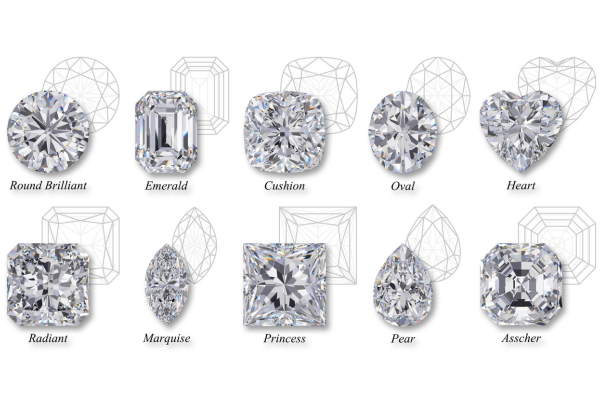
In addition to the round shape, there are other popular shapes: oval, princess, emerald, pear, radiant, and heart. There are many diamond shapes and each of them has its own aesthetic qualities. It is important to mention that all these shapes are variants of the same mineral – diamond.
The round brilliant remains the most desirable. The choice of shape depends on the buyer’s needs.
1 carat of diamond and brilliant
A carat is a unit of weight.
1 carat = 0.20 g, therefore the term carat in grams is often used.
The price for 1 ct of brilliant is usually higher than for 1 ct of diamond because it is a specially processed stone.
Not all diamonds are the same
It is important to know that not all diamonds are suitable for jewelry. Only high-quality stones are certified and used in jewelry. The rest are often industrial diamonds.
Gemstone certificates – ruby
Ruby is one of the most popular gemstones. The certificate indicates its color, origin, and possible treatments. Rubies without a certificate should not be purchased.
Gemstone certificates – sapphire
Sapphire is evaluated by color, clarity, and origin. The most luxurious sapphires are from Kashmir, Myanmar, and Sri Lanka. The certificate confirms whether the sapphire is not artificially dyed.
Gemstone certificates – emerald
Emeralds often have natural inclusions. The certificate indicates their quality, origin, and treatments. Without a certificate, it is difficult to determine an emerald’s value.
Practical tips for the buyer
- Always ask for a certificate.
- Check the certificate number in the GIA, HRD, or IGI database.
- If in doubt, consult with a jeweler.
Comparison: Natural diamond vs Lab Grown diamond vs Imitation stone
| Type | Origin and composition | Is it a real diamond? | Certificate (GIA, HRD, IGI) | Price of 1 carat diamond* | Price of 1 carat brilliant* | Notes |
|---|---|---|---|---|---|---|
| Natural diamond | Forms deep in the Earth’s depths over millions of years | Yes ✅ | Yes, international certificate mandatory | from €1500 and more | from €1800 and more | Rare, unique, considered an investment |
| Lab Grown Diamond | Grown in a laboratory by recreating natural processes | Yes ✅ | Yes, certified according to the same standards | from €400–1800 | from €500–1800 | More ecological, budget-friendly |
| Imitation diamond (imitation: moissanite, cubic zirconia, etc.) | Synthetic or glass crystals visually resembling a diamond | No ❌ | Certificates do not apply | from €50–200 | from €100–300 | Visually similar, but does not have the properties of a diamond |
* Prices are indicative and may vary by color, clarity, cut, and market fluctuations.
Diamond, brilliant, ruby, sapphire, or emerald – they are all gemstones whose value depends on the certificate.
International documents such as GIA, HRD, IGI provide reliability. The Lithuanian Assay Office ensures that every stone is sold transparently.
Frequently asked questions about gemstone certificates
1. Why is a diamond certificate important?
A diamond certificate confirms the stone’s authenticity, quality, and value according to international standards. Without a certificate, the diamond’s price in the market can be unclear or even misleading.
2. What is the difference between a diamond and a brilliant?
A diamond is a natural mineral, and a brilliant is a diamond cut with a round 57–58 facet cut. Due to this cut shape, the stone’s brilliance and beauty are most highlighted.
3. Are lab-grown diamonds real diamonds?
Yes, laboratory-grown diamonds (Lab Grown Diamonds) are real because they have the same chemical composition as natural ones. They differ only in origin – grown in a laboratory rather than in the Earth’s depths.
4. What are artificial diamonds?
Artificial diamonds are imitations such as cubic zirconia or moissanite. They visually resemble a diamond but do not have the same properties, so their price is significantly lower.
5. What is special about the GIA certificate?
The GIA (Gemological Institute of America) certificate is considered the “gold standard.” It most strictly evaluates diamond clarity, color, carat weight, and cut, making it the most reliable for buyers and jewelers.
6. Is the EGL certificate reliable?
EGL certificates are in the market, but their evaluations are often more lenient than GIA. Differences can reach up to 2–2.5 color grades, so the price of an EGL-certified diamond may look more attractive, but the real value is lower.
7. Who checks gemstones in Lithuania?
All diamonds, rubies, sapphires, and emeralds in Lithuania must be checked at the Lithuanian Assay Office. This ensures that the stone meets CIBJO standards.
8. What does the Lithuanian Assay Office determine?
The Assay Office evaluates the authenticity and main parameters of gemstones. However, they do not record criteria such as diamond cut, symmetry, or polish, so international certificates remain important.
9. Is a certificate necessary for lab-grown diamonds?
In Lithuania, a certificate for laboratory-grown diamonds is not mandatory, but it is recommended to have an IGI or GIA document. This provides transparency and ensures the true value of the ring or brilliant.
10. Are certificates necessary for rubies, sapphires, and emeralds?
Yes, especially for colored stones. Certificates help determine the origin and treatments of a ruby, sapphire, or emerald. The most reliable are Swiss laboratories – SSEF and Gübelin, which are considered the most authoritative in the world.