
When choosing jewelry, especially diamond bracelets, many face the question of which gold fineness is best. This choice affects not only the beauty of the bracelet but also its longevity, comfort, and price. Just like with wedding or engagement rings, fineness is one of the essential criteria that must be understood before purchasing.
Below, we will discuss what fineness is, how different gold finenesses differ, why it is important to understand the concept of 585 fineness, and how to choose the most suitable option for bracelets, including tennis bracelets or other elegant diamond bracelets.
What is fineness and why is it important for a bracelet?
Fineness is a measurement unit that indicates how much pure gold is in an alloy, i.e., how many parts of pure gold are out of 1000 parts of the alloy. Pure gold is too soft to be suitable for jewelry, so it is mixed with other metals such as silver, copper, or palladium.
The higher the gold fineness, the more pure gold there is in the product, i.e., a higher amount of pure gold in the alloy. Fineness is determined by the amount of pure gold in the mass of the alloy, but at the same time, the bracelet becomes softer and requires more care. Therefore, the question of which gold fineness is best for diamond bracelets is highly relevant—after all, such a bracelet is often worn daily.
Most popular gold finenesses for bracelets
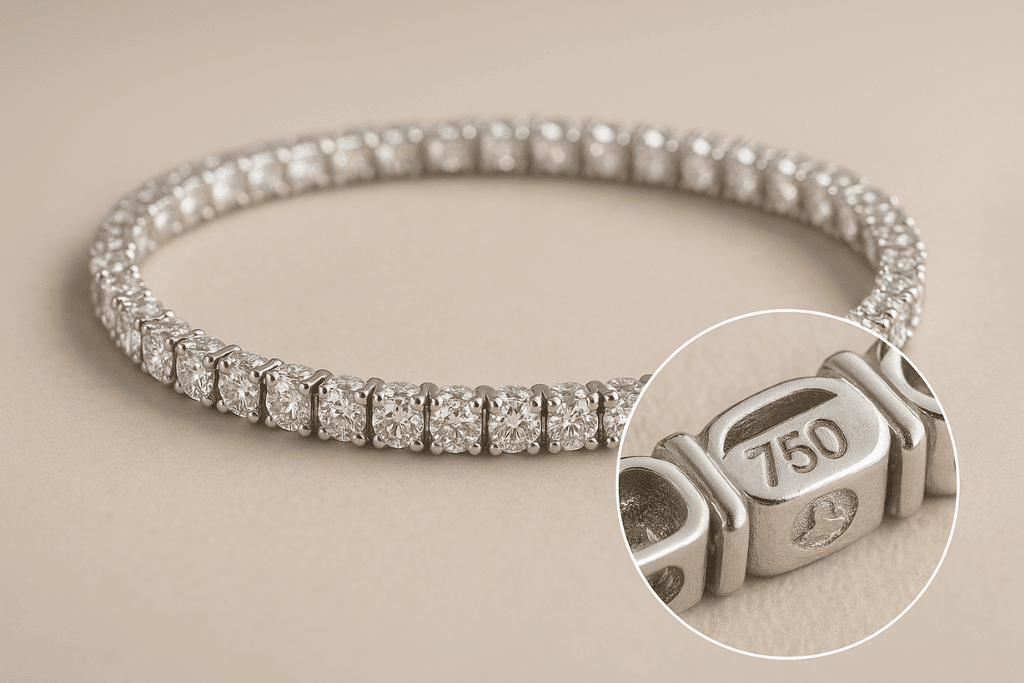
Several standard finenesses are used in jewelry production, which you will recognize by the number stamped inside the bracelet. The most commonly used finenesses are 375, 585, and 750. These finenesses are internationally recognized and used in many countries. Hallmarks are important because they indicate how much pure gold is in the alloy and determine the properties and value of the piece of jewelry.
- 375 fineness (9k) – contains only 37.5% pure gold. This fineness is standard and marks how much precious metal is in the alloy. These bracelets are cheaper, stronger, but less shiny.
- 585 fineness (14k) – the most popular in Lithuania, providing a balance between beauty and durability. 585 fineness is standard, marking that the alloy contains 58.5% pure gold.
- 750 fineness (18k) – contains 75% gold, looks very luxurious, but is softer, making it less resistant to daily wear. 750 fineness is standard and indicates a higher pure gold content, which is why such pieces are valued higher.
Gold fineness table for bracelets
| Fineness | Carats | Pure gold content | Properties |
|---|---|---|---|
| 375 | 9k | 37.5% | Economical, hard, less shiny |
| 585 | 14k | 58.5% | Most popular, strong and shiny |
| 750 | 18k | 75% | Luxurious, but softer |
| 999 | 24k | 99.9% | Pure gold, not suitable for bracelets |
The amount of pure gold is indicated out of 1000 parts – for example, 585 fineness means that 585 parts out of 1000 parts of the alloy are pure gold. The amount in the alloy determines the value and properties of the fineness: the higher the amount of pure gold in the alloy, the higher the fineness and the more valuable the product.
585 fineness – the most practical choice for bracelets
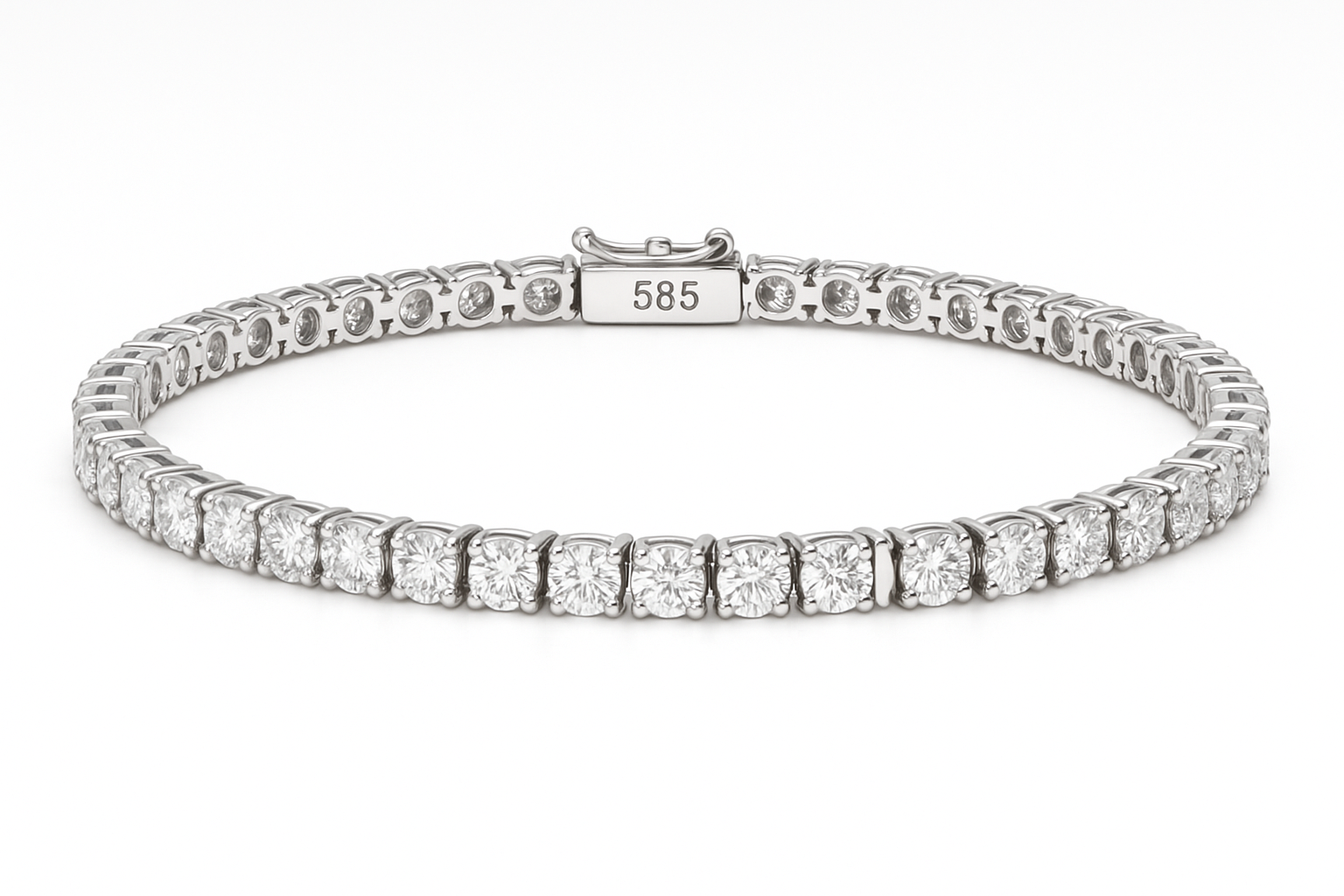
Gold fineness 585, or called 585 (14K) fineness, is the most universal because it balances durability and elegance. Diamond bracelets must be strong enough, so this fineness is recommended. It is precisely because of these properties that it is most commonly used not only for rings but also for bracelets, explaining its popularity.
The price of 585 gold is generally affordable compared to higher fineness products, yet such bracelets look luxurious and hold their shape. This explains why many buyers choose this specific fineness when purchasing diamond bracelets.
Gold colors and their fineness
The gold fineness determines not only the hardness but also the color of the gold. The color of gold depends on which metals are mixed into the alloy – their type and proportions determine the final shade and color, as well as other properties of the gold alloy.
- Yellow gold – a classic option where the color is derived from an alloy of gold, silver, and copper. This gold alloy retains the natural shade of gold, while silver and copper provide it with strength.
- White gold – a popular choice for bracelets, mixed from an alloy of gold and white precious metal (e.g., palladium or nickel). It is often coated with rhodium, making its surface extremely shiny. The fineness of white gold can be 585 or 750, and the price of white gold is often higher due to additional processing.
- Rose gold – the reddish tint is provided by an alloy of copper and gold, where there is more copper, giving the bracelet a warmer, more intense shade.
Mixing different metals into the alloy allows for various gold colors, and the color depends on their proportions. The gold alloy determines not only the color but also other properties of the piece of jewelry.
Gold fineness and myths
When talking about bracelets, it is important to mention Russian gold fineness. Russian gold traditions are based on a slightly different system – 583 fineness is more commonly used there, which is quite frequent in Russian jewelry, very close to our 585, but lower. This fineness is also still recognized on older products.
If you buy a bracelet from an antique shop or an inherited piece, you might find such a hallmark, but that does not mean it is a “good” fineness.
Diamond bracelet: fineness determines longevity
When choosing a diamond bracelet, especially if it is a tennis bracelet, it is very important to choose the right fineness. Finenesses are different and are chosen according to individual needs and wearing frequency – the more often the piece is worn, the more important it is to choose a stronger fineness. These pieces of jewelry are worn often, so the gold needs to be strong enough to hold the gemstones.
Therefore, the question of which gold fineness is best gains even more meaning here – 585 fineness or 750 fineness is usually recommended because it ensures that the bracelet will be long-lasting and reliably hold the joints. It is also important to consider the construction of the bracelet and the setting of the diamonds.
White gold fineness for bracelets
Modern diamond bracelets are often made of white gold. White gold fineness is usually 585 and 750. Yes, because of these finenesses, white gold bracelets are popular as they provide a good balance of quality and price. Such bracelets look modern, especially if they are set with diamonds.
White gold with rhodium plating is even more resistant to oxidation and acquires a special shine. Therefore, if you dream of an elegant tennis bracelet, white gold is one of the most popular choices.
Gold carats – what you must know!
Gold carats, another unit of measurement, are one of the main indicators determining how much pure gold is in the jewelry alloy. The more carats, the higher the relative amount of precious metal, but at the same time, the gold becomes softer. For example, 24 carats mean the gold is almost entirely pure (999 fineness gold), while 18 carats correspond to 750 fineness gold, 14 carats to 585 fineness gold, and 9 carats to 375 fineness gold.
In Lithuania, the gold fineness and hallmarking process are strictly regulated by the Law on State Supervision of Precious Metals and Gemstones of the Republic of Lithuania. All gold products are inspected and marked by the Lithuanian Assay Office – only they can confirm that the fineness is accurate and corresponds to the declared amount of pure gold. This is especially important when buying gold online or from unknown sources – only an official hallmark ensures that you are purchasing a genuine precious metal product.
When choosing a diamond bracelet, it is worth knowing that gold carats determine not only the value but also the color and durability. Therefore, before purchasing, it is worth inquiring about the gold fineness and what alloy metals were used – this will help you choose not only a beautiful but also a long-lasting piece of jewelry that will maintain its appearance for many years.
Is it always worth choosing the highest fineness?
Although 750 fineness provides more luxury, it is not the best for diamond bracelets intended for daily wear. It is softer, so the surface can scratch more quickly.
For daily wear, 585 fineness is the most practical – it ensures a balance between price, beauty, and durability, and the fineness must be strong enough to withstand constant use.
Who oversees the accuracy of gold hallmarks?
All bracelets in Lithuania are marked with the hallmark of the Assay Office. This is an official quality guarantee confirming that the product meets the established standards.
Therefore, when purchasing a diamond bracelet, always check if the hallmark is clearly visible on the product – it is usually stamped on the inside of the bracelet.
Which gold fineness is best for diamond bracelets?
If you want a long-lasting piece of jewelry, 585 fineness is the most universal choice.
- 375 fineness is suitable for economical solutions.
- 585 fineness – the most popular option for daily wear.
- 750 fineness – a luxurious choice for special occasions.
The most important thing is to ensure that the bracelet is marked with an official hallmark and manufactured according to quality standards.


Silver and palladium, and hallmark standards in Lithuania: