GIA DIAMOND CERTIFICATE
The GIA Diamond Certificate includes an evaluation of the diamond’s 4 “Cs” – Color, Clarity, Cut, and Carat weight – as well as a marking on the diamond’s girdle: a microscopic GIA certificate number laser inscription that allows for easy identification of the diamond. This certificate provides detailed information about the diamond’s characteristics and origin.
To purchase a GIA-certified diamond, we invite you to visit our FashionGold.lt and browse our full range of GIA-certified diamonds.
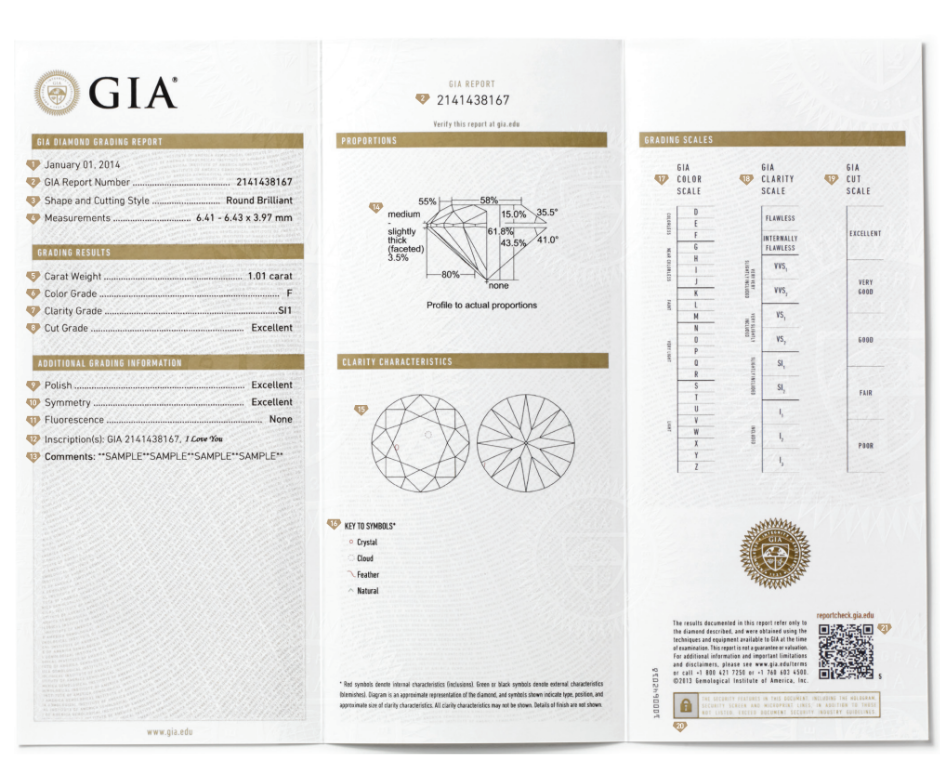
You can always check your diamond’s GIA certificate online – simply enter the certificate number or the code found on the diamond’s girdle and instantly find all information about its authenticity.
How to read a GIA diamond certificate?
- Date: The date when the diamond was certified by GIA. The certification time is an important indicator of its value.
- Report Number: A unique GIA certificate number registered in the GIA global database. This number allows you to track information from the GIA database.
- Shape and Cutting Style: The shape of the diamond and the facet arrangement pattern (cutting style).
- Measurements: The diamond’s dimensions; for round diamonds, it indicates minimum diameter – maximum diameter x depth, for fancy shapes – length x width x depth. This information is important for an accurate diamond evaluation.
- Carat Weight: The diamond’s weight in carats. One carat is equal to 0.20 grams.
- Color Grade: Color is classified in alphabetical order from colorless “D” to “Z,” where a yellow or brown tint is visible to the naked eye. If there is an asterisk (*) next to the color grade, it means a color enhancement was detected. GIA has created a clear color grading system.
- Clarity Grade: The amount of inclusions and flaws in the diamond under 10x magnification. It is evaluated on a grading scale from “Flawless” (no flaws) to “Included” (visible to the naked eye), considering the size, nature, quantity, location, and prominence of characteristics. The certificate indicates what inclusions are in the diamond.
- Cut Grade: For standard round diamonds, the cut grade includes appearance, design, and craftsmanship. It is evaluated on a scale from “Excellent” to “Poor.” This is one of the most important diamond quality characteristics.
- Polish: The smoothness of the diamond’s surface, evaluated on a scale from “Excellent” to “Poor.” Polish quality can be a factor that determines a diamond’s brilliance.
- Symmetry: The precision of the diamond’s facets, the accuracy of facet shapes, placement, and alignment, evaluated on a scale from “Excellent” to “Poor.”
- Fluorescence: The diamond’s glow under ultraviolet rays, classified from “None” (no fluorescence) to “Very Strong.”
- Inscriptions: Any text, symbols, logos, or the unique GIA certificate number inscribed on the diamond’s girdle.
- Comments: Additional characteristics or features not listed elsewhere in the certificate. If the diamond has been treated (enhanced), such as laser drilling, it will be described in this section. After treatment, all changes are clearly indicated here.
- Proportions Diagram: A graphic representation of the diamond’s actual proportions.
- Clarity Plot: A graphic illustration of the diamond’s clarity scale inclusions. This diagram helps to understand where the main inclusions are located in the diamond.
- Key to Symbols: Inclusion descriptions with markings.
Diamond Grading Scales according to GIA
- GIA Color Scale: Illustration of the GIA diamond color evaluation system.
- GIA Clarity Scale: Illustration of the GIA diamond clarity evaluation system.
- GIA Cut Scale: Illustration of the GIA diamond cut evaluation system. Used for standard round brilliant diamonds D–Z.
- Security Features: Microprinting, security screens, watermarks, 2D barcode tags, holograms, and sheet numbering protect the GIA certificate and ensure certificate authenticity.
- QR Code: A barcode tag that, when scanned, allows you to verify the diamond certificate in the GIA database.
The GIA laboratory issues certificates for unmounted natural diamonds starting from 0.15 carats in the D–Z color range. GIA is an organization that ensures diamond authenticity on a global scale. Diamond certificates are not issued for synthetic diamonds, diamond simulants, or enhanced (treated) diamonds where inclusions are filled or coated, or for diamonds subjected to the HPHT process. Any other treatments are clearly stated in the report if the diamond meets the requirements.
The issuance of each new certificate is a significant event in the market.
Natural Diamond Treatments or Enhancements:
Some diamonds are treated (enhanced) to improve their color or visible inclusions, thereby increasing their value. All GIA diamond grading certificates indicate any detected treatments. Color and clarity treatments are specified in the “Comments” section (No. 13). Additionally, color treatments are indicated with an * next to the diamond color characteristic (No. 6). GIA does not issue certificates for diamonds with filled or hidden inclusions. One of GIA’s main goals is to ensure transparency in the market.
Examples of Diamond Color Treatment:
- Coating: Masking a diamond’s natural color with an ultra-thin layer of chemicals or plastics. Since this treatment is considered unstable, GIA does not issue certificates when coating is detected.
- HPHT (High Pressure, High Temperature): Heating a diamond at high temperatures under high pressure to remove or change its color. Some treatments may affect the diamond’s value.
Examples of Diamond Clarity Treatment:
- Laser Drilling: A small hole drilled into the diamond with a laser to remove an inclusion or create a channel through which bleaching agents can be introduced to improve the inclusion’s appearance. Usually used to remove small black inclusions.
- Fracture Filling: Filling a crack with a glass-like substance to improve the diamond’s visible clarity. Since this treatment is considered unstable, GIA does not issue certificates for diamonds with fracture filling.

Lab-Grown Diamonds:
A synthetic lab-grown diamond is the result of a technological process rather than a natural geological process. Synthetic diamonds are grown and have essentially the same chemical composition, crystal structure, and optical and physical properties as a natural diamond. Because synthetic diamonds are almost identical to natural diamonds, differences only become clear upon inspection by an experienced grader. GIA issues lab-grown diamond grading reports, which look visually different from natural diamond reports.
Diamond Simulants:
Simulants are materials that only look like diamonds. Common diamond simulants include glass and cubic zirconia (CZ), which are completely unrelated to diamonds. GIA does not issue certificates for diamond simulants. Only GIA-certified diamonds carry the highest level of reliability.
About diagrams: these diagrams help to better understand the diamond’s characteristics.
GIA Certificate Storage
Storing the GIA certificate is a crucial step for anyone investing in diamonds or other gemstones where authenticity and value are the main criteria. This document not only confirms your stone’s origin and characteristics but can also become important evidence in legal situations or when selling the stone back into the market. A GIA certificate is often the only document that can prove your gemstone’s authenticity, so its storage should be a priority.
If the certificate happens to be lost or damaged, GIA offers the possibility to order a new copy. This can be done by contacting GIA directly and providing the necessary information about the stone and its certificate number. All GIA-certified stones require special attention – it is recommended to keep the original certificate in a safe place and use a digital copy for everyday needs. With changes in legislation and increasing focus on authenticity, storing the GIA certificate becomes even more relevant.
From 2025, GIA began issuing new certificates with additional security features to further protect documents from forgery or unauthorized copying. This innovation emphasizes that a GIA certificate is not just a fashion document, but an investment document whose loss could have serious consequences. What is important to know – even if the certificate is lost, GIA always offers solutions to restore the document, but keeping the original remains best practice.
By taking care of your GIA certificate, you are not only protecting your investment but also ensuring that no issues will arise in the future regarding the stone’s authenticity or value. This is especially important in the jewelry industry, where every detail can affect the value of your asset.