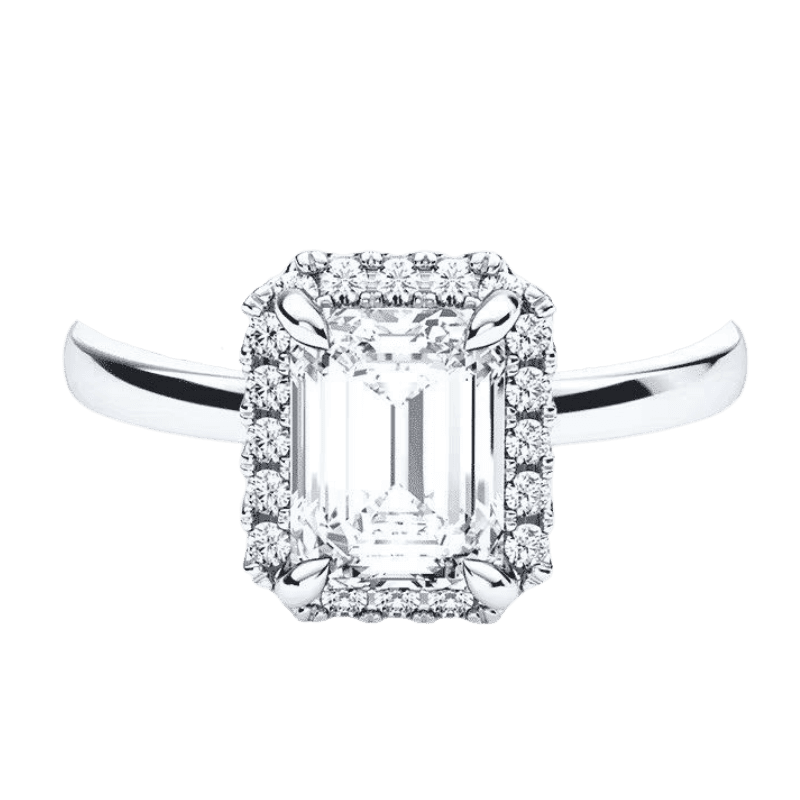
How to distinguish natural diamonds from lab-grown diamonds and diamond imitations. Advice from the GIA Gemological Institute.
Understanding the Differences
Natural diamonds have long fascinated people due to their unique visual and physical properties. Interestingly, the word “diamond” comes from the Greek “adamas,” meaning “invincible.” This name emphasizes the diamond’s symbolic meaning—it has long been considered a symbol of eternity and fidelity.
The exceptional properties of diamonds—hardness, durability, light reflection (brilliance), and light dispersion (fire effect)—set them apart from other stones. Diamonds and other stones are valued based on their shape, cut, and processing, which determine their appearance, value, and investment benefits. The beauty and investment appeal of natural diamonds come with a price, as the extraction and processing of these rare gemstones is a complex process. For decades, scientists have sought alternatives, creating cheaper “analogous” imitations and “copies” in the form of synthetic diamonds. While human attempts to replicate the properties and structure of natural diamonds are not new, the rapid development of lab-grown diamond technologies over the past decade has raised significant concerns regarding their identification.
For more than 60 years, the GIA (Gemological Institute of America) has monitored the development of lab-grown diamonds. This continuity, combined with core research conducted on tens of millions of natural diamonds, allows the GIA to accurately identify lab-grown diamonds.
To protect yourself from misinformation and the incorrect presentation of natural diamonds, lab-grown diamonds, and diamond imitations, it is important to understand the differences between them and the methods for identifying them.
Unlike diamond imitations, which can be identified using standard gemstone tests, lab-grown diamonds have essentially the same chemical composition and crystal structure as natural diamonds, but they are grown in laboratories rather than formed deep within the Earth. Thus, natural diamonds and lab-grown diamonds form separate groups of stones and have different origins, even though their properties are very similar. Because their optical and physical properties are almost identical to natural diamonds, identifying synthetic (lab-grown) diamonds is a complex process. However, due to artificial growth conditions in the laboratory, lab-grown diamonds possess several diagnostic features that allow them to be detected in gemological laboratories.
Natural Diamonds
Natural diamonds are a true scientific wonder because they form only when carbon atoms are subjected to high pressure and high temperature about 160 kilometers below the Earth’s surface, in what is known as the upper mantle layer. Diamond crystals reside in these extreme mantle conditions for millions of years. Crystals growing under these conditions have a unique structure that we associate with natural diamonds.
Natural diamond crystals sometimes incorporate small solid inclusions of diamonds or other minerals into their structure, which grow along with them. Although mineral inclusions are often considered a negative feature of a cut diamond’s clarity, they are extremely valuable to geologists. Natural diamonds provide an opportunity for these mineral inclusions to be preserved and brought to the Earth’s surface, where they can be studied by scientists. Since certain inclusions contain radioactive elements that decay at a known rate, minerals can also be used to calculate the age of diamond formation.
After a long stay in the mantle, some diamonds are brought to the Earth’s surface along with volcanic eruptions of kimberlite magma. Geologists believe that diamonds are transported through the magma over a distance of 160 kilometers very quickly (in just a week or more), so the diamonds do not change or turn into graphite. However, during this rapid journey upward, a diamond crystal may break along cleavage planes or undergo other changes that can affect, for example, its color. Whether a diamond remains resistant to such conditions and maintains its authenticity are frequently discussed questions in gemology. Diamonds come in various colors, shapes, and clarities, making each stone unique.
Lab-Grown Diamonds
The use of synthetic diamonds (lab-grown diamonds) for jewelry is a relatively new process, although lab-grown diamonds for industrial purposes have been grown since the 1950s. Unlike natural diamonds, lab-grown diamonds are grown in laboratories over a very short period—likely in just two or three weeks (sometimes even less). A longer growth period results in larger crystals; however, this requires maintaining constant environmental conditions to ensure high-quality crystal formation. Currently, lab-grown diamond production is most commonly encountered in the format of small-sized crystals. The short growth period of lab-grown diamonds results in characteristics that are important for distinguishing them from natural diamonds.
Two artificial growth methods are used to create synthetic diamonds: HPHT and CVD.

HPHT (High Pressure/High Temperature) synthesis, developed in the 1950s, uses high temperature and pressure, a molten metal flux, and a diamond seed to initiate crystal formation. The result is a characteristic crystal shape consisting of octahedral and cubic faces and a flat base. The HPHT process more closely mimics the natural conditions of diamond formation than CVD.

The CVD (Chemical Vapor Deposition) method, which has been primarily developed over the last decade, produces diamonds using low-pressure and high-temperature conditions in a vacuum chamber. A carbon-containing gas, such as methane, is introduced into the chamber, where the gas molecules break down into their components. Carbon atoms “rain” onto flat diamond seed plates, resulting in square-shaped, flat synthetic diamond crystals.
Diamond Imitations

Since ancient times, various materials have been used as diamond imitations or substitutes. These materials, often called diamond simulants, can form naturally in the earth or be artificially grown in a laboratory. In the past, colorless varieties of some colored stones (e.g., quartz) were used to imitate diamonds. Today, the most common imitations are cubic zirconia (zirconium oxide or CZ) and, to a lesser extent, synthetic moissanite (silicon carbide). Because imitations are completely different from diamonds, they have diagnostic properties by which they can be identified using standard gemstone testing methods, observation under magnification, and commercially available “diamond testers.”
Identification of Lab-Grown Diamonds
Due to the different growth conditions of natural and lab-grown diamonds, lab-grown diamonds possess several characteristics that allow them to be gemologically distinguished from natural diamonds. These characteristics include visual signs such as color zoning, dark metallic inclusions, faint strain patterns, and characteristic ultraviolet fluorescence patterns and colors. Because they correspond to types of diamonds rarely found in nature, lab-grown diamonds also have additional properties that can be identified using gemological instruments. When evaluating diamonds, color and clarity are often marked on a scale from D to M or from VVS1 to I3, so these parameters must be carefully checked.
Decades of research and the use and improvement of advanced scientific instruments allow the GIA (Gemological Institute of America) to accurately identify lab-grown diamonds. However, analyzing diamonds set in jewelry is difficult due to gold settings that cover the diamond.
Information on the identification of lab-grown diamonds has been widely published in the GIA’s peer-reviewed journal “Gems & Gemology” over the past 30 years.
About GIA
The Gemological Institute of America (GIA) – founded in 1931, the GIA has researched the properties of gemstones, developing new methods for identifying natural, synthetic, and treated gemstones. This research helps protect everyone who buys and sells gemstones by ensuring accurate and unbiased standards for identifying and characterizing gemstone quality. GIA research results are incorporated into educational programs, published in professional journals, used to develop practical instruments and tools, and applied daily in performing grading and identification services.
Diamonds have long been recognized as a symbol of luxury and investment, and their price depends on quality parameters and market demand. Color, shape, and cut have a major impact on a diamond’s value, and colored diamonds, called “fancy,” stand out for their rarity and investment potential. Diamonds are always associated with eternal love, success, and long-term value, which is why they remain exceptionally valued in both the jewelry and investment worlds. When choosing a diamond, you are recommended to consider individual needs and preferences, as each stone is unique. A properly cut diamond reflects light perfectly and creates an exceptional sparkle that has fascinated for many centuries.
What is a Diamond
A diamond is a natural gemstone formed from pure carbon when it has been subjected to high pressure and high temperature deep in the Earth’s mantle for millions of years. A diamond is not only one of the most valuable stones in the world but also symbolizes eternity, fidelity, and luxury. Diamonds are valued not only for their exceptional beauty but also for the symbolic meaning they have acquired over centuries. A diamond can be found raw or processed into various shapes, such as round, oval, cushion, princess, heart, rectangular, pear, marquise, and others. Diamonds are special gemstones because they possess the highest hardness of all natural stones, making them extremely scratch-resistant and durable. Due to these properties, a diamond is not only desirable in jewelry production but is also considered an exceptional natural gemstone that remains valuable for many years.
The Difference Between a Diamond and a Brilliant
Although these terms are often used synonymously, “diamond” and “brilliant” are different concepts. A diamond is a natural stone that can come in various shapes and sizes, while a brilliant is a round-shaped diamond cut in a specific way, having 57 or 58 facets. A diamond can be processed into various shapes, such as princess, heart, oval, or cushion, but only the round-shaped cut is called a brilliant. The value of both a diamond and a brilliant depends on the 4Cs: carat (weight), color, clarity, and cut quality. All brilliants are diamonds, but not all diamonds are brilliants—this depends on their shape and cutting style. A diamond is a natural gemstone that can be processed in various ways, while a brilliant is only one, but the most popular, diamond cut form, distinguished by its exceptional light reflection and sparkle.